
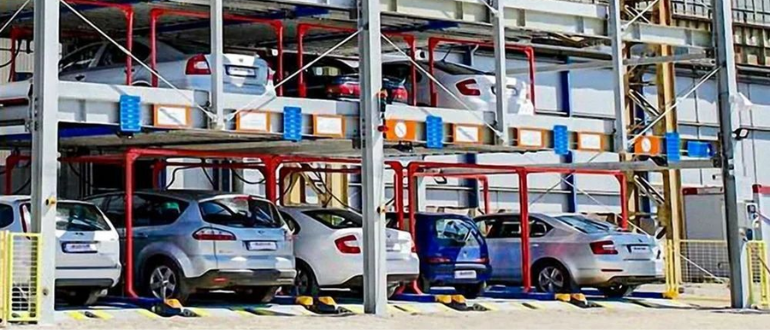
Automated systems can achieve a much higher parking density, and in congested market places or business areas, they eliminate the need to drive around searching for a spot, significantly reducing traffic congestion in parking areas and surrounding streets.
Noida Authority is planning to build its first automated puzzle parking in Sector 63. Designed by Orionn Architects, the four-level facility to be managed through RFP will have a capacity of 100 vehicles (25 per floor) and will use a sensor-based mechanism to automatically shift vehicles between floors in 3–6 minutes, offering faster, safer, and space-efficient parking. As per General manager SP Singh the facility is designed to ease parking woes in places where space is limited with poor parking conditions.”
Tower car parking systems too offer a compelling alternative by maximizing the use of vertical space and automating the parking process. These systems installed in quite a few commercial buildings, retail hubs, and office towers in Mumbai can accommodate up to 100 cars in the space required for just 2-6 surface parking spots.
While, automated car parks are ill suited for public use or market places, they are best for residences and offices, says Arvind Mayar. On a positive note, he adds, “There are several success stories specially in many cities including Delhi and Mumbai, of public car parks developed by municipal, metro or urban development authorities. Many of these have some retail attached to improve customer convenience.”
For instance, to address the chronic menace of traffic congestion, the Lucknow Municipal Corporation in May this year has introduced 100 on-roadside parking spots across several key areas in the city. Additional municipal commissioner Pankaj Shrivastava said the survey identified 74 existing parking locations that were closed after the revision of urban parking rules, which prohibited roadside parking. “Basic amenities like drinking water, toilets and shade will also be developed at these parking sites as per govt directions,” he added.
Decoding the Urban Parking Dilemma
The National Urban Transport Policy 2006 (NUTP) advocates the imposition of parking fees commensurate with land valuation costs, establishing park-and-ride facilities at transit nodes, a tiered system of parking fees, and creating multi-level parking structures in urban cores. Many cities across India such as Surat, Ahmedabad, Delhi, Pune, Kolkata, Bengaluru, and Chandigarh, among others, have formulated parking policies for their respective urban areas.
But on a closer look the multiplicity of governing bodies from police to municipals, outdated building codes, commercialization of streets by vendors and incoherent urban land use guidelines have left the parking directives not aligned with desired objectives
An inclusive, intelligent urban planning is the need of the hour, that may include multi-level parking systems, community parking bays, digitized mapping, and incentives for off-peak travel to ease this urban menace.
It is imperative, solutions must consider not only vehicle volume but also human experience.